Quick answer
Paligo is the stronger fit for cloud structured authoring, content reuse, branching, translation management, and multi-channel publishing. TwinWorks fits teams connecting modular technical documents with product visuals, interactive procedures, relationship-based impact review, and execution evidence.
What each product is
Paligo describes itself as a cloud-based component content management system for structured topic authoring, reuse, collaboration, versioning, localization, and multi-channel publishing.
The reviewed Paligo pages document XML-based topic authoring, a customized DocBook content model, topics and publications, variables and conditional filtering, branching and versioning, collaboration and review, translation management, and publishing across formats and channels. See the official sources used for this review.
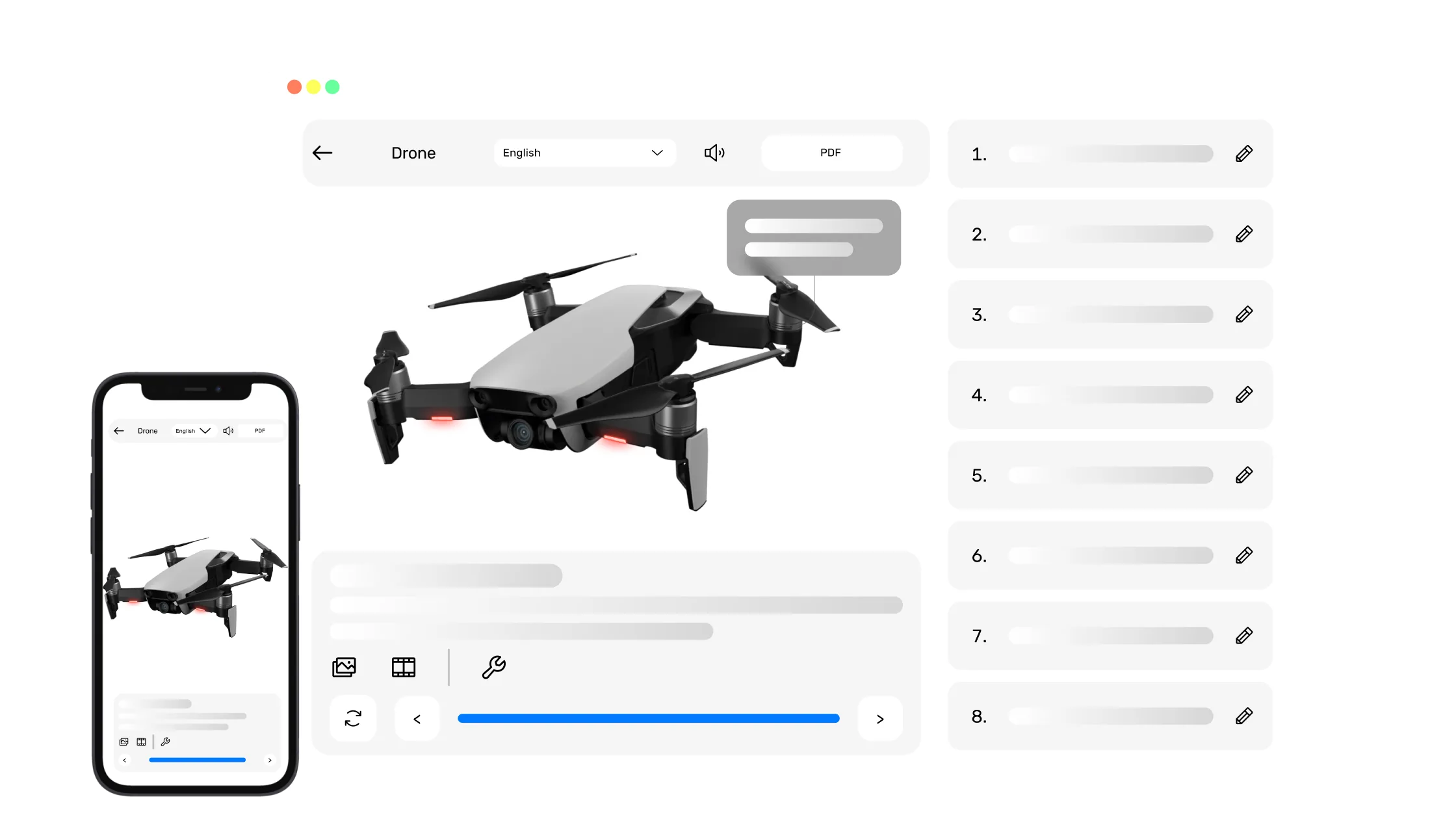
TwinWorks combines AI-assisted technical-publication authoring with interactive procedure authoring and execution. Technical-document drafts can be grounded in linked manuals and parsed engineering data; reviewers can comment, request changes, and approve technical-document revisions. Procedure drafts are grounded in uploaded PDFs, and authors edit and review them before release.
Factual workflow comparison
The table describes verified or officially documented workflows; it is not a universal feature score. Packaging and integrations can vary, so confirm the proposed configuration with each vendor.
| Workflow | TwinWorks verified position | Paligo official position | Evidence |
|---|---|---|---|
| Primary workflow | Technical-document authoring and interactive procedure authoring and execution in one product. | Cloud CCMS workflows for creating, managing, translating, reviewing, reusing, and publishing technical documentation. | [1] [4] |
| Content creation | AI prepares review-ready technical-document drafts from linked manuals and parsed engineering data. Technical-document review includes approval and approved revisions; procedure drafts are grounded in uploaded PDFs and remain under author edit, review, and release control. | Topic-based structured authoring separates content from layout and supports topics, publications, elements, attributes, variables, and conditional content. | [2] [3] |
| Content reuse and governance | Modular technical content includes per-block provenance and approved revision history. TwinWorks does not claim general XML or DITA interchange. | Reuses topics or smaller elements across publications, tracks where content is used, supports branching and versions, and maintains an audit trail. | [2] [3] |
| Engineering and 3D | Imports GLB, self-contained GLTF, FBX, OBJ, and USDZ; STEP/STP is beta. Imported 3D supports visual authoring, but the current default flow does not generate procedure steps from CAD. | Reviewed official pages emphasize structured documentation and integrations rather than product-linked CAD, interactive 3D, or engineering-structure parsing. | [1] [4] |
| Change and review control | Finds content through explicit part, tool, consumable, source, and procedure relationships and flags broken or stale dependencies. It does not provide a complete arbitrary CAD-revision blast radius or automatic update and approval. | Centralized cloud collaboration, reviews, versioning, branching, reuse relationships, and single-source updates govern documentation change. | [3] |
| Publishing and frontline use | Authors and runs assembly, disassembly, maintenance, usage, and quality-control procedures, capturing step status, duration, comments, replays, serial/operator fields, ratings, and optional photos. | Publishes reusable content to multiple formats, channels, products, regions, and languages. Reviewed pages do not describe interactive task-execution records. | [1] [2] [4] |
| Execution evidence | Execution reports export to PDF, DOCX, and XLSX. Current execution records are not verified as immutable proof of the exact procedure revision used. | Reviewed pages focus on content governance and delivery rather than per-step status, photos, duration, or execution-report exports. | [1] [3] |
| Implementation context | Publishes technical documents and procedures for web use. AR guidance is limited/beta for prepared tracking anchors; universal device compatibility is not claimed. | Cloud delivery centralizes authors, contributors, reviewers, translation workflows, and publishing; structured-content migration and governance remain part of adoption. | [1] [3] |
Best fit by buying priority
Paligo is the better fit when
- A cloud CCMS with mature topic reuse, variables, profiling, branching, and multi-channel publishing is the primary requirement.
- Large documentation sets span many products, regions, languages, and output channels.
- Technical writers need structured authoring and translation-management workflows.
- Frontline procedure execution and product 3D are outside the main buying scope.
TwinWorks is the better fit when
- Technical documents must connect directly with interactive product visuals and executable procedures.
- The product team needs relationship-based where-used and impact review across parts, tools, sources, and embedded procedures.
- Execution evidence and report exports belong in the same documentation workflow.
- A general cloud CCMS content model is less important than product-centered documentation and guidance.
TwinWorks scope and limitations to test
- No automatic CAD-to-steps claim: imported 3D supports visual authoring, while current procedure-draft generation is grounded in uploaded PDFs.
- Relationship-based change impact: where-used and impact review depend on explicit content relationships; TwinWorks does not claim a complete automatic blast radius from any CAD revision.
- Human-controlled change: the product can flag affected content and prepare suggestions, but it does not automatically update or approve every deliverable.
- Format boundary: GLB, self-contained GLTF, FBX, OBJ, and USDZ imports are verified; STEP/STP import is beta and should be tested with representative assemblies.
- Document and procedure records differ: approved revision history is verified for technical-document content. Current execution records are not verified as immutable proof of the exact procedure revision used.
- AR boundary: AR guidance is limited/beta for prepared tracking anchors; universal device support is not claimed.
How to evaluate the two products
Use one reusable procedure shared across product variants and languages, plus one executed instruction. Compare authoring, reuse, translation, review, output fidelity, product visuals, impact discovery, and execution evidence.
- Use representative source content and product data rather than a vendor sample.
- Record the expert time required to draft, review, approve, translate, and revise.
- Introduce one real change and observe how affected content is found and controlled.
- Execute the procedure and inspect the evidence, exports, integrations, and revision assumptions.
Official sources and methodology
Competitor information was checked on 10 August 2026. The links below are official vendor sources and describe vendor-stated capabilities, not independent certification. Confirm plan, region, integration, and release availability during procurement.
- Paligo cloud CCMS overview — official Paligo source.
- Paligo structured authoring — official Paligo source.
- Paligo single sourcing and version management — official Paligo source.
- Paligo for commercial manufacturing — official Paligo source.
FAQ
Workflow-specific answers for this comparison.
Is TwinWorks a Paligo replacement?
Not universally. TwinWorks can be evaluated for product-centered technical documents and interactive procedures, while Paligo remains the stronger fit for a general cloud CCMS, structured topic reuse, localization, and multi-channel publishing.
When is Paligo the better fit?
Paligo is the better fit when documentation teams need cloud structured authoring, mature content reuse, variables, branching, translation management, and publishing across many products and channels.
When is TwinWorks the better fit?
TwinWorks fits when modular technical documents must connect with product visuals, interactive procedure execution, relationship-based impact review, and captured execution evidence.
What should an evaluation test?
Use one reusable procedure across product variants and languages, then execute it. Compare reuse, translation, review, output fidelity, product visuals, impact discovery, and execution evidence.
Explore the comparison set
Review all ten maintained pages in the technical-documentation and work-instruction comparison hub.

Compare one reusable publication workflow
Bring one manual family, one reused procedure, and one product change. We will show TwinWorks' verified workflow and identify where a cloud CCMS remains the better architecture.