
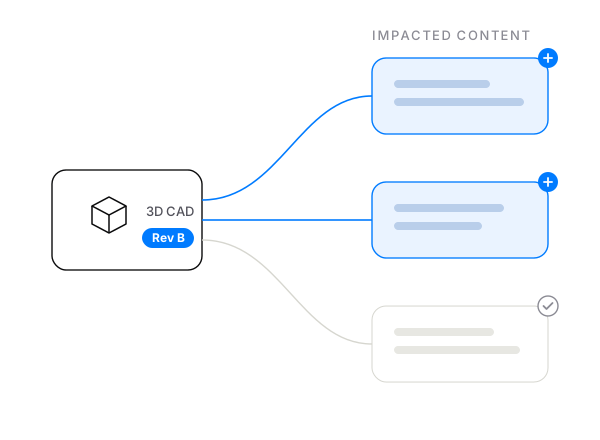
Immediate answer: keep technical documentation aligned by treating every approved engineering change as a traceable workflow. Identify potentially affected content, assign an owner, revise the controlled source, obtain the required expert approvals, release one authoritative revision, and verify that users received it. CAD, PDM, PLM, or documentation software can surface relationships and prepare review work; it cannot decide engineering meaning or approve a safety-critical change on its own.
Why documentation falls behind the product
Engineering changes and documentation updates often travel through different systems, teams, and release calendars. A part number changes in PLM while a manual refers to the old assembly by description. A reusable warning appears in several publications, but only one copy is updated. A PDF is revised, while an older download, printout, or technician cache remains available.
The practical problem is not simply “slow writing.” It is the missing evidence between a changed product fact and every place that fact is used. The workflow needs to answer four questions:
- What changed? Record the approved source, revision, reason, effectivity, and responsible owner.
- What might be affected? Find linked topics, illustrations, warnings, procedures, translations, and output variants.
- Who decides? Route each candidate to the people authorized to assess and approve its meaning.
- How is closure proven? Preserve review, release, delivery, and supersession evidence.
A seven-step engineering-change documentation workflow
- Capture the approved change record. Start from a controlled engineering change notice, release, or equivalent record—not an informal message. Include identifiers, old and new revisions, effectivity, and the product configurations in scope.
- Build the candidate impact set. Search structured links, part references, model associations, text, illustrations, warnings, translations, and known downstream outputs. Label this a candidate set until an accountable reviewer confirms it.
- Triage impact with subject-matter experts. Engineering confirms technical meaning; documentation assesses content reuse and outputs; quality, safety, service, or regulatory owners join where their controls apply.
- Revise the reusable source. Update the smallest controlled content units that accurately express the change. Preserve source references, applicability, revision history, and any rationale needed for review.
- Review the change, not just the finished page. Give reviewers a clear before-and-after view, the initiating engineering record, affected configurations, and unresolved questions. Record decisions and comment resolution.
- Release and supersede deliberately. Publish only after required approvals. Mark the approved revision, retire obsolete outputs, and retain the previous revision according to the organization’s retention rules.
- Verify delivery and use. Check the channels that matter: portal, service system, line-side device, training package, supplier handoff, or printed controlled copy. Capture exceptions and feed them back into the change record.
Use a change-impact record that reviewers can audit
A compact impact record prevents the update from disappearing into email and gives each reviewer the same evidence. Adapt the fields to your quality system rather than copying a generic template unchanged.
| Field | Purpose | Evidence at closure |
|---|---|---|
| Change source | Connect the work to an approved engineering record and effectivity. | Identifier, revision, approval state, and configuration scope. |
| Candidate content | List topics, media, warnings, procedures, translations, and outputs to assess. | Confirmed impact, no-impact rationale, or follow-up owner. |
| Review path | Make required roles and decisions explicit. | Resolved comments, approvals, and release authorization. |
| Delivery scope | Identify every channel and audience that needs the approved content. | Publication status, supersession status, and delivery exceptions. |
Design the content model for impact analysis
Impact analysis becomes more reliable when content carries durable identifiers and explicit applicability. A topic linked to a product configuration, component, task, tool, or hazard is easier to assess than a page whose only context is its position in a PDF. Reusable content also reduces duplicate edits—but only when teams can see where each source module is published.
A technical publications workflow can centralize structured source content, review, version history, and multichannel output. The value depends on the relationships and governance the team establishes; importing a file does not automatically create trustworthy traceability.
Measure the workflow without inventing certainty
Use operational measures that can be calculated from your own records. Define the start and end state before comparing periods.
- Change-to-publication lead time: elapsed time from an approved engineering state to the required documentation release.
- Impact decision coverage: affected candidates with a recorded impact or no-impact decision.
- Overdue change actions: open documentation tasks beyond the organization’s agreed target.
- Post-release corrections: documentation issues traced to a missed, late, or incorrect change assessment.
- Delivery exceptions: channels or audiences that did not receive or acknowledge the approved revision as expected.
These measures describe the sampled process; they do not prove compliance or causation by themselves. Review outliers with the people who own the work.
Start with one representative change
Choose a recent change that touched more than one content type or delivery channel. Bring the engineering record, the current documentation, the review trail, and evidence of what users received. Mapping that single path usually reveals where identifiers, ownership, approvals, or supersession are unclear.
If shop-floor procedures are already drifting, read why work instructions become outdated and how to reconnect change triggers with point-of-use delivery.
Map a real engineering change with TwinWorks
Bring one approved change and one affected document set. We will scope a working conversation around impact discovery, review evidence, release, and delivery. This is a manual commercial assessment—not an automated repository scan or compliance audit.