Change discovery
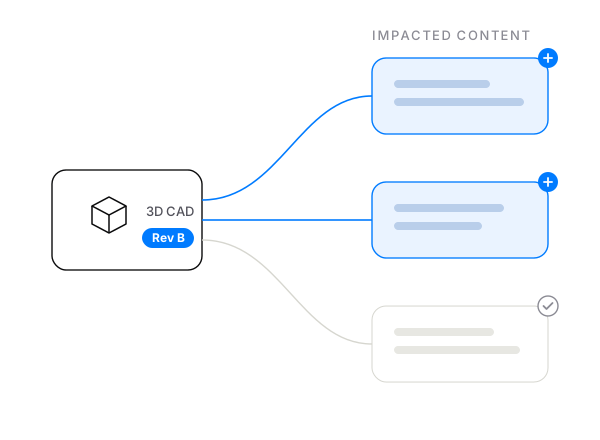
How does the team find every manual, reusable block, or procedure affected by a changed product fact?
Documentation Drift Scan
Request a practitioner-led assessment of how product changes reach manuals and work instructions, how revisions are reviewed, and what evidence returns from execution. We use representative examples to find the most credible improvement priority.
This is a scoped working assessment—not an automated scan, instant score, compliance audit, or background upload.
Where drift appears
Documentation drift is not one metric. It appears as slow updates, disconnected sources, unclear approvals, stale delivery, and execution evidence that cannot close the loop. The assessment focuses on the parts visible in your chosen sample.
How does the team find every manual, reusable block, or procedure affected by a changed product fact?
Can reviewers see what changed, trace its source, resolve comments, and identify the approved document revision?
How does approved content reach users, and what execution, deviation, or field evidence returns to the documentation team?
How the assessment works
There is no browser-based questionnaire pretending to know your operation. The useful work happens with people who understand the current process and examples that expose where it breaks.
Bring a real example
You do not need to prepare a complete repository export. One recently changed item and the documentation trail around it can expose the current discovery, review, delivery, and feedback path.
The session can end with a findings discussion and a prioritized next test. If your team needs a written summary or other deliverable, agree its scope before the review.
Honest assessment boundaries
The Drift Scan is a commercial discovery exercise. It helps frame a documentation problem and a measurable next step; it does not certify the process or infer facts from systems that were never reviewed.
Nothing on this page silently scans repositories, product data, or connected systems.
We do not turn a few answers into a synthetic percentage or guaranteed benchmark.
The assessment is not certification, a legal opinion, or a substitute for accountable quality and regulatory experts.
Explore the underlying workflows
No. It is a practitioner-led assessment based on a working conversation and representative evidence that your team chooses to share. It is not an automated crawler or instant scoring tool.
Useful examples include a recent engineering change, a technical document or work instruction, the associated approval path, and any execution or field feedback that shows how updates are handled today.
No. TwinWorks does not generate a fake instant maturity score. The scope, evidence to review, findings discussion, and any written follow-up are agreed before the working session.
No. It is a commercial working assessment, not a certification, legal opinion, or regulatory compliance audit. Your accountable quality and regulatory experts remain responsible for formal conclusions.
Choose a real change, document, or execution workflow. We will agree the scope, work through the evidence, and identify a credible next test.